Tampilkan postingan dengan label kidnapping. Tampilkan semua postingan

Rabu, 26 Mei 2010

Daily Times : Muslim Cleric accused of kidnapping, converting Hindu girl in Pakistan

Source Daily Times (Pakistan)
Wednesday,May 26,2010
(Main Mosque in Rahim Yar Khan District,Punjab,Pakistan)

* Radha’s family claim she was forcibly converted in madrassa
* Police ignoring family’s complaints, say they should forget about the girl

By Afnan Khan

LAHORE : The leader of a madrassa allegedly abducted a minor Hindu girl from Rahim Yar Khan and did not let her parents meet their daughter, claiming that the girl had converted to Islam and no longer wanted to meet her “non-Muslim relatives”.

Radha (13) was abducted in December 2009, her parents told Daily Times, adding that they had “knocked on every door stretching from the president of Pakistan to Punjab chief minister and chief secretary, but to no avail”. “Local police, including the former and current district police officers of Rahim Yar Khan, are supporting the people who abducted Radha and are neither registering a first information report (FIR) against the accused, nor are they taking any action to recover the girl from the custody of Abdul Jabbar and Naveed,” they alleged.

Several human rights activists and local Hindu leaders have termed the incident “another case of forced conversion” and slammed the government for not addressing the concerns of the victim’s family.

Mehnga Ram – Radha’s father – told Daily Times that his daughter had been missing since December 21, 2009, and that the family had searched for her everywhere before some friends informed them that their girl was in the possession of the leader of the Darul Aloom in Khanpur.

“We went to the Abdul Jabbar, the head of the madrassa, and others and requested them that our girl be returned to us.”

Forget the girl: They initially denied that Radha was in their custody, but later admitted the fact only to then tell us that they could not allow us to meet our daughter since she had converted to Islam and did not want to see any of her non-Muslim relatives,” the father said, adding that he then went to the authorities, seeking to register an FIR against the culprits, but the police said they could not register an FIR because the “girl had converted and the family should just forget the matter”.

“We took local Hindu leaders and other respected people to the authorities in order to push them to lodge an FIR against Abdul Jabbar, but the officials sent us to then DCO Imtiaz Gul, who after listening to our story took our applications, but did nothing except delay the case and make false promises,” Mehnga said, adding that for months, the family sent applications to “every authority”, but to no avail.

He said there were only a few human rights activists and family friends who were supporting him because he was extremely poor and his only source of income was from a shoe polish stall, adding that local police officers and seminary heads – fearing any action that may be taken against them after the family started sending applications to the authorities concerned – had consented to arrange a meeting between Radha and any one of her family members and had also claimed that Radha had married a Muslim boy named Naveed.

Prakash, Radha’s brother, who went to the meeting a few weeks earlier, told Daily Times that he had met Radha for only a few minutes in the presence of Naveed’s family members and people from the seminary.

“There was absolute silence in the room. With tears in her eyes, Radha could only give short answers to my questions, including why she had gone missing and converted. My sister could only muster up the courage to say that she had converted and was happy,” Parkash said, adding that a few minutes into the meeting, he was told by the people in the room to leave and gave him a number on which he could contact Radha. “That number has been turned off from the day they provided it,” he said, adding that his family is extremely disappointed over being “ignored” by the authorities. “We only curse ourselves for being so poor and sometimes even for being non-Muslims in a country where religion matters. We are not expecting justice from any one and it is simply over for us now,” Prakash said.

Separately, a human rights activist based in the area, Ramesh J Pal, told Daily Times that he had been one of the people who had attempted to pursue the Radha case and had raised the issue at every possible platform, but no significant result could be achieved. “I personally met Abdul Jabbar, but he never entertained any of our requests. This is a clear case of forced conversion. Meanwhile, Dr Araish Kumar, an MNA elected on the reserved seat for minorities, told Daily Times that Radha’s case was clearly one of forced conversion and that he would personally talk to Punjab Chief Minister Shahbaz Sharif and request him to act against the seminary chief and the people behind the crime.

However, Parliamentary Secretary for Human Rights Tahir Khalil Sindhu told Daily Times that he had received an application on the case and was already planning to take action against the people concerned.

He said that he would bring the case to the notice of the Punjab CM so that action is taken against the culprits.

Jumat, 26 Maret 2010

Police turn blind eye to rampant kidnapping and rape of Hindu girls in Pakistan's Sindh province

Source http://www.sindhtoday.net
Friday, March 26, 2010
Karachi, (ANI): A 12-year-old Hindu girl, Nandini, is still missing as police officials have failed to recover her even after four months of her being allegedly picked up by an influential individual of the city.  

Officials have no information regarding Nandini's whereabouts, who was kidnapped in December last year, and the accused named Younis has not been arrested despite the fact that there is a first information report (FIR) registered against him.  

It is not an isolated case where Hindu families have been left with little choice than to lament over their fate, with no help in sight from the authorities. 

Several Hindu families, which are at the receiving end of the government's apathy, are awaiting justice for years but there's no one to listen to their plight.  

According to Roshni Research and Development Welfare Organisation (RRDWO), a non-government organisation (NGO), a research has shown in majority of cases involving the minority community, police only provide lip service and do not seriously hunt down the criminals.  


The NGO's President, Muhammad Ali, cited another case of a 17-year-old Hindu girl, who was kidnapped and raped by four men, in January this year. All the four accused were granted pre-arrest bail by a session court.  

"Rape is a non-bail able offence in Pakistan and this is against criminal procedure and the law," The Daily Times quoted Ali, as saying. Ali said the Asian Human Rights Commission has also expressed its serious concern over the case. "Instead of giving justice to the victim's family, the police later arrested the victim's father on a false offence, and have obstructed attempts by the family to file an FIR and obtain a medical report," he added. Ali also disclosed that an 'illegal' tribal court had asked the victim girl to marry her rapist and convert to Islam following which the girl had threatened public self-immolation.  

"Not arresting the rapists and rather forcing a Hindu girl, who is a rape victim, to convert to Islam and be the wife of the culprit could be double trauma for the victim. It is another form of further victimising a woman," he said.  

Ali also appealed to the Chief Justice of Pakistan, Justice Iftikhar Mohammad Chaudhry to take suo moto notice of the gross human rights violations of the poor and the marginalized minorities in the Sindh province at the hands of police and lower judiciary, who are influenced by the feudal and local elite. (ANI)

Senin, 22 Maret 2010

Kidnapping reflects fears of Pakistan minorities

Source http://www.dawn.com
Monday, 22 Mar, 2010
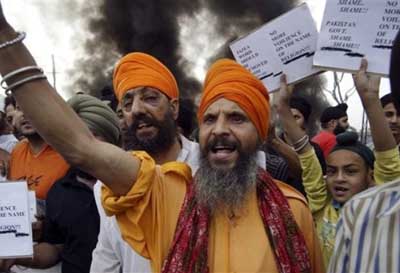
In a country beset by a powerful Islamist insurgency, where suicide bombings are commonplace and government offensives widely dismissed as ineffective, anyone can become a victim. – Reuters Photo 

PESHAWAR: Five Sikh men who fled their hometown on the Afghan border were making a quick trip back home when masked men blocked their way with a pickup on a mountain road not far from the Khyber Pass.

There were no houses, no buildings, no other cars in sight. The kidnappers covered their faces with black scarves and carried machine-guns.

Surjeet Singh had just wanted to check on the small grocery store he had left behind in Dabori, the Pakistani town he fled a year ago when it was overrun with Taliban fighters and the government launched a bombing campaign against them. In an area torn by Islamist violence, it had quickly become a dangerous place for a non-Muslim.

Singh and the four friends traveling with him that day all wore the carefully wrapped turbans that made their Sikh religion clear.

They were going back to pick up money they were owed, or to check on their businesses. They had called friends ahead of time to check on the situation. They thought a quick trip would be safe.

“We were born there. We grew up there,” said Singh, who today is recovering from a bullet wound in a small apartment in a crowded maze-like neighborhood of Peshawar, the largest city in Pakistan’s northwest. “Our forefathers had been there for hundreds of years. We have houses, shops, land.”

In today’s Pakistan, though, that is not enough.

In a country beset by a powerful Islamist insurgency, where suicide bombings are commonplace and government offensives widely dismissed as ineffective, anyone can become a victim. But for the nation’s minorities – its small communities of Hindus, Christians and Sikhs – life is particularly precarious. Thousands have fled their villages, crowding into urban slums. Thousands more have fled the country.

“With the rise in militancy in our society in general, and in the northwest in particular, minorities are feeling more threatened,” said I.A. Rehman, a senior official with Pakistan’s Human Rights Commission. He noted that many Sikhs have been driven from their homes, and those that remain are now often forced to pay the militants a “jizya” – a traditional tax for non-Muslim.

Singh’s journey, which began on a cold morning in January and ended 42 days later with a March 1 bloody gunbattle, underscores the threats to those minorities, as well as the lawlessness of Pakistan's frontier regions.

Two months later, it’s still not clear exactly why the Sikhs were targeted: Were the bandits waiting for them? Would they have kidnapped anyone who came by?

Certainly their religion made them easier targets, since it is more difficult for them to make use of the region’s informal power networks, the tribal and religious leaders who can protect people in the semiautonomous areas.

On that day, though, as armed men swarmed toward their car, shouting for the five Sikh men to move quickly, all Singh and his friends were thinking about was survival.

Two if them managed to slip away amid the chaos, but three – all sharing the same common Sikh surname, Singh – were quickly captured.

“They held us at gunpoint, immediately dragged us out of our car,” said Surjeet Singh, a quiet composed man. He and his friends were blindfolded and driven for about an hour. Then they began walking.

They could see nothing through their blindfolds. They could only feel cold pressing in as they climbed higher into the Hindu Kush mountains.

After hours of walking, they were brought to a set of rooms carved into the mountainside. It would be their home for the next 42 days. There they would be kept chained and often blindfolded. Occasionally, they were beaten. The prisoners never saw their captors’ faces – which were always covered with scarves – and even now they do not know who they were.

They clearly were militant Muslims, forcibly cutting their prisoners hair. Keeping hair uncut is a deeply important religious precept for Sikh men.

But the real reason for the kidnapping was quickly clear: money.

Surjeet Singh did not want to talk about ransom demands but the other survivor, 18-year-old Gurvinder Singh, told the Times of India newspaper that their captors brought them mobile phones on their first morning in the cave. They were ordered to call their families and say their freedom would cost 50 million rupees, or about $600,000. When it was clear that money could not be raised, the number dropped to 20 million rupees, or $240,000.

After that: nothing. The men made no further phone calls, their captors barely spoke to them. Their days passed in silence.

“Every day was like a month, and a month was like a year,” Singh said.

After a few weeks, Jaspal Singh was suddenly taken away.

The other Sikhs were told he’d been freed. “You will also be released if you give us money,” their captors taunted them.

In the end, though, their captors got nothing.

Twelve days after Jaspal disappeared, the thunder of helicopters filled the air as teams of Pakistani commandos swarmed the camp.

The government has declined all comment on the incident. – AP